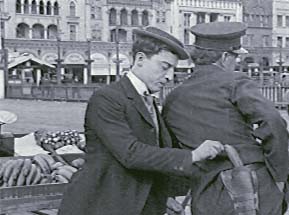
Occupation Actor, Director Born Joseph Frank Keaton VI on the 4th October, 1895 Married Natalie Talmadge (1921 - 1932) Divorced, had 2 Sons Mae Scriven (1933 - 1936) Divoprced Eleanor Norris (1940 - 1 February 1966) 1920 - 1966 Of Lung Cancer, 1st February, 1966, Los Angeles, USA. Joseph Francis Keaton Jr. was a child star in his family's roughhouse slapstick vaudeville act The Three Keatons, where the young Buster developed the acrobatic skill and comic timing which would distinguish his great silent films. In 1917 he began acting in support of Fatty Arbuckle in numerous short comedies, including The Butcher Boy, Fatty At Coney Island, and The Garage, which gained Keaton enough attention to be chosen to star in the 1920 feature-length farce The Saphead. His uniquely personal brand of comedy, with an unsmiling Buster persevering in a confounding world of willful machines, not-very-bright girlfriends, menacing heavies, and even-more menacing police, was launched with a series of brilliant shorts in the early '20s. He co-wrote and co-directed most of those films with Eddie Cline, among them the classics The Playhouse, The Boat, and Cops; Cline also shared the honors on Keaton's first official feature, the Intolerance-parody The Three Ages (1923). A series of hilarious, uniquely cinematic comedy features followed, highlighted by Keaton's extraordinary stunts and the unexpected dark twists which occasionally surfaced in his humor. Unsurpassed at constructing elaborate and original sight gags, Keaton brought a new vision to silent comedy with his masterpieces Our Hospitality (1923), Sherlock Jr. (1924), The Navigator (1924), Seven Chances (1925), The General (1927), College (1927), and Steamboat Bill Jr. (1928) -- films which made him second only to Chaplin as an internationally beloved comedy star. Signing with MGM in 1928, Keaton scored with his last silents, The Cameraman (1928) and Spite Marriage (1929), both nominally directed by Edward Sedgwick. The studio demanded more control over Keaton's talking films, and his career quickly collapsed as he delivered ordinary jokes in a series of low-budget comedies, frequently teamed with Jimmy Durante. An uncredited gagman for Red Skelton in the 1940s, Keaton's reputation began to rise again in the '50s, thanks in part to his live stage shows and his appearance in Charlie Chaplin's Limelight (1952). Although Keaton would never again create the kind of films that made him one of the giants of world cinema, his final years nevertheless included memorable performances in Film. Alan Schneider's production of Samuel Beckett's original screenplay, and director Richard Lester's comic musical A Funny Thing Happened on the Way to the Forum (1966). |